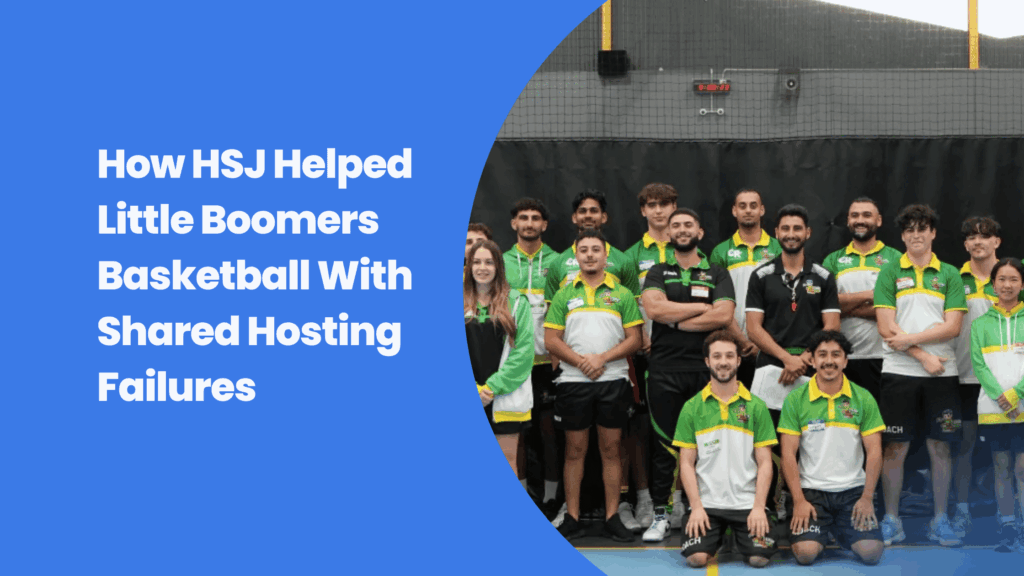
Little Boomers Basketball, founded by Emile Koorey, runs a busy kids’ basketball program. Parents need the website up when they’re booking, checking times, or chasing an answer after work. When the site was slow or offline, it was not a “IT inconvenience”. It was lost enquiries and a team stuck firefighting instead of coaching.
This is how we moved them off shared cPanel hosting with another provider onto Linux VPS with HSJ Host, split live and development onto two servers, and later deployed Mia phone AI so easy enquiries stopped eating the day. It is a case study, not a feature brochure, and it is one of the clearest examples we have of why shared hosting vs VPS matters once a real business depends on the stack.
Who we worked with
Emile Koorey is the founder of Little Boomers Basketball. He built a kids’ basketball franchise that now depends on a website franchisees and parents can trust during peak booking periods. When that site kept dropping on shared hosting, it was not a side issue. It was hitting the people running locations in the network.
Emile later left a public Google review about the move. We are quoting it here because social proof should come from the client, not from us rewriting their story.
I came to HSJ Hosting at a really desperate time. Our previous web hosting company had us on a shared server, and our website kept going down during peak periods, which was frustrating our franchisees. James moved us to a VPS for around a third of the price, and since then our website hasn’t gone down once. More importantly, James is a hands on business owner who is in the trenches with us, active in our group chats and constantly monitoring performance. Massive thank you for everything, James.
Emile Koorey, Founder of Little Boomers Basketball (Google review)
That matches what we set out to do. Fix the environment, stay close to the team, and stop peak-period downtime being the weekly drama. You can also read Emile’s founding story on the Little Boomers Meet the Founder page.
The situation before HSJ Host
Little Boomers were on shared cPanel hosting elsewhere. On paper that can be fine for a light brochure site. In practice they were living with
- Unreliable uptime and performance dips at the worst times
- Outages and errors that kept getting blamed on “a plugin issue”
- Not enough visibility to prove what was actually failing, whether server, neighbour noise, or the application
- A support loop that left their team guessing instead of fixing
Shared hosting fails often look like WordPress problems from the outside. A plugin update coincides with a slow node, someone points at the plugin, and the hosting story never gets inspected properly. Without clear reporting (resource use, error history, what the server was doing when the site fell over), a business can burn weeks “optimising plugins” while the real constraint is the environment.
That gap costs money. Downtime loses bookings. Wrong diagnoses waste staff time. And every hour spent arguing about symptoms is an hour not spent running the program.
How we approached it
HSJ Host’s job here was not to sell a bigger plan and disappear. We treated the engagement the way we try to treat every serious client relationship. People first. An extension of their team.
- Listen to what was breaking in the business, not only what the ticket subject line said
- Separate hosting symptoms from application symptoms
- Give them an environment with dedicated resources and room to change things safely
- Keep communication plain about what we found, what we changed, and what to expect next
If you are in a similar spot and want that kind of review before you move, talk to us. If you already know you need dedicated resources, start with Linux VPS Hosting.
The move to Linux VPS
We migrated Little Boomers from the old shared cPanel account onto an HSJ Host Linux VPS for production. That gave them
- Dedicated CPU, RAM and NVMe-backed storage instead of a noisy shared pool
- Root-level control when the stack needed real changes
- Australian infrastructure and support they could actually reach
- Reporting and visibility that made the next incident diagnosable
The point of the migration was not “VPS because VPS sounds serious.” It was to stop paying for downtime and guesswork. Once the live site sat on its own resources, the pattern of random failures and plugin finger-pointing stopped being the weekly story.
For the buyer-side checklist we use with other migrations, see what to look for before you buy a Linux VPS in Australia.
Two servers for live and development
Production stability is only half the job. Little Boomers also needed somewhere to build and test without gambling the public site.
So they now run two Linux VPS servers.
- Live environment for the public site parents and staff rely on
- Separate development box where changes can be tried, reviewed and broken safely before they go near production
That split sounds obvious in hindsight. On shared hosting it is awkward or impossible to do properly. On two VPS instances it is normal. Ship when ready, not when a plugin update on live happens to survive the afternoon.
If you are still on shared hosting and every change feels risky, that is often the signal you have outgrown the model, not that WordPress itself is “broken.”
What changed after the migration
The short version is that the uptime and stability issues draining the business stopped being the plot.
- The site stopped falling over in ways that looked like random plugin weather
- When something did need attention, we had the environment and reporting to look in the right place
- The team got time back with less downtime theatre and fewer “is it us or the host?” loops
- Changes could move through a proper live and dev path instead of straight onto the public server
That is the money story too. Lost downtime is not only a refund or a frustrated parent. It is staff hours, missed bookings, and reputation. Moving to Linux VPS did not magically make WordPress perfect. It removed the shared-hosting failure mode that was being mislabelled as application drama.
Mia phone AI cutting easy enquiry calls
Hosting was the foundation. The phone was still eating time.
Like a lot of local sports businesses, Little Boomers get repeat questions about hours, programs, how to join, and quick answers parents need now. Those calls matter, but they do not all need a human on the first ring.
We deployed Mia, a phone AI receptionist setup, to handle the easy enquiries and quick answers. Roughly 80% of those human-related calls on simple questions no longer need to pull a staff member out of the day. The team still handles the conversations that need a person. Mia takes the repetitive layer.
That is not “AI for the blog.” It is operational leverage on top of a stack that finally stays up. A clever phone layer on an unreliable website still loses people. Stable hosting plus fewer interrupt-driven calls is what actually saved them time.
Why this matters if you are still on shared hosting
Little Boomers’ story is specific, but the pattern is common.
- Shared hosting is blamed on plugins when the node cannot show its work
- There is no safe place to test, so every change is a production risk
- Support replies arrive without the metrics that would end the argument
- The business keeps paying in downtime and distraction
Shared cPanel hosting is still the right start for many smaller sites. When uptime, traffic, or change velocity start affecting revenue, Linux VPS is the sober next step, especially if you want a separate development environment rather than editing live and hoping.
The HSJ Host bit, people first
Hardware matters. So does who picks up when something is weird at 7pm before a training night.
With Little Boomers we were not trying to be a faceless ticket queue. We acted as an extension of their team. Diagnose properly, migrate carefully, leave them with live and dev that make sense, then keep helping on the operational extras (like Mia) that actually return hours to the business.
That is the standard we hold ourselves to on Australian Linux VPS work. If your current host keeps blaming plugins without proving the server side, it may be time for a second opinion.
Want a similar setup?
If you need dedicated resources, a proper live/dev split, or a migration off shared hosting that does not leave you guessing
Compare Linux VPS plans · Talk to our team · Read when VPS beats shared hosting