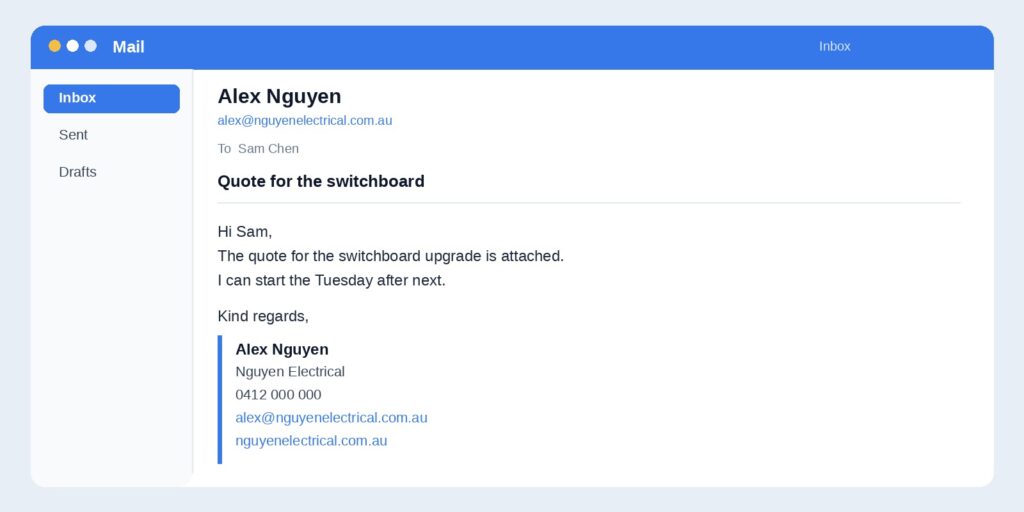
Short answer: end the email with the next step, then one sign-off, then your name. For most business mail in Australia, use Kind regards. Use Thanks when the other person has done something. Use Cheers only with people you already know.
Those last lines are what someone sees when they scroll back to find who wrote. One line is enough. A sign-off is not the place for a quote, a joke, or a second closing stacked under the first.
Say what happens next, then stop
The sentence before the sign-off should tell the reader what to do, or what you will do. “I will send the quote this afternoon.” “Let me know if Thursday at 10 still suits.” “The invoice is attached.” Then stop. Kind regards cannot fix an email that never said what it was for.
If you are replying in a thread, you do not need to repeat the whole story. One sentence on the decision, then the sign-off, is easier to read than a fresh introduction.
Email sign offs that work

An email sign off is that one line. These are the ones worth keeping.
- Kind regards. The default. A first email to a customer, a supplier, or anyone you do not know well.
- Regards. The shorter version. Fine on a reply once you are already talking. A bit abrupt on a first email.
- Thank you. Use this on the first email when they have already done something, such as sending a brief or booking a time. Thanks is the same idea once the thread is underway.
- Cheers. People you email often. Not a first quote, not a complaint, and not a note about an overdue invoice.
- All the best. A warmer close when you know them and the email is not about money.
Pick one and use it. Kind regards and Cheers under the same message looks undecided.
Sign-offs to leave out
- Best on its own. It reads as if the sentence was cut off.
- Yours sincerely and Yours faithfully. Those belong on a formal letter. A two-line email does not need them.
- Sent from my iPhone as the only close. It does not say who you are.
- A lyric, a joke, or a line you would not say out loud to that customer.
- A long disclaimer in place of a sign-off. If a lawyer has asked you to add one, put it under your name, not instead of it.
Match the sign-off to the email
The examples below are made-up businesses, so you can see the shape. They are not real customers.
A first email from a sole trader to a new customer:
I can be on site Tuesday morning to look at the switchboard. I will confirm the time on Monday.
Kind regards
Alex Nguyen
Nguyen Electrical
A reply after someone has confirmed a time:
Thursday at 2:30 is booked in. We will send a reminder the day before.
Thanks
Priya Shah
Harbour Dental
A shared inbox, where no single person should sign with a nickname:
The October statement is attached. Payment is due on the 14th.
Kind regards
Accounts
Northside Timber
Chasing a late payment stays polite in the sign-off. The sentence above it carries the request. Cheers is the wrong line on that email. Kind regards is the right one.
Where the sign-off ends
Kind regards is the sign-off. Your name is the next line. The phone number, business name and website under that are a separate block, and the whole team should use the same order. What belongs in those lines is covered in what to include under your name.
Agree the sign-off once. Kind regards for anything new or anything about money. Thanks once you are already in a thread. Cheers only where you would say it in the room. Then each person changes their name, and nothing else about the close.